

Chris Rangen
Guest article: Innovation Superclusters - what are they and how can they boost Northern Ireland’s economy?

Globally, countries compete on the quality of their key economic sectors. For many countries, this means backing dynamic innovation clusters as backbones of their innovation economies. To compete for the future, the opportunity for Northern Ireland is to launch, lead and scale successful innovation clusters. Long-term Northern Ireland should focus on a few, high-value Innovation Superclusters.
What are Innovation Superclusters, and why do they matter?
Innovation clusters are a concentrated group of businesses and research institutions that collaborate to promote technology transfer, networking, and information dissemination within a specific sector and region.
Every region has clusters. Very few have Superclusters.
There are thousands of formal clusters worldwide, but in our research less than 150 stand out as genuine Innovation Superclusters. They are large, industry-led collaboration platforms, built around the industries of the future and designed to drive system-level innovation at scale. From Canada's Ocean Supercluster to Norway's seafood and energy clusters, they share one trait: they are actively built, not left to chance.
For decades, European industry policy rested on the triple helix: industry, government and academia working together. That model built strong networks, but it left out two forces that now drive modern economies. Superclusters move from the triple helix to the pentagram, adding:
- Entrepreneurs: startups, scale-ups, incubators and accelerators.
- Capital: early-stage and growth-stage risk capital.
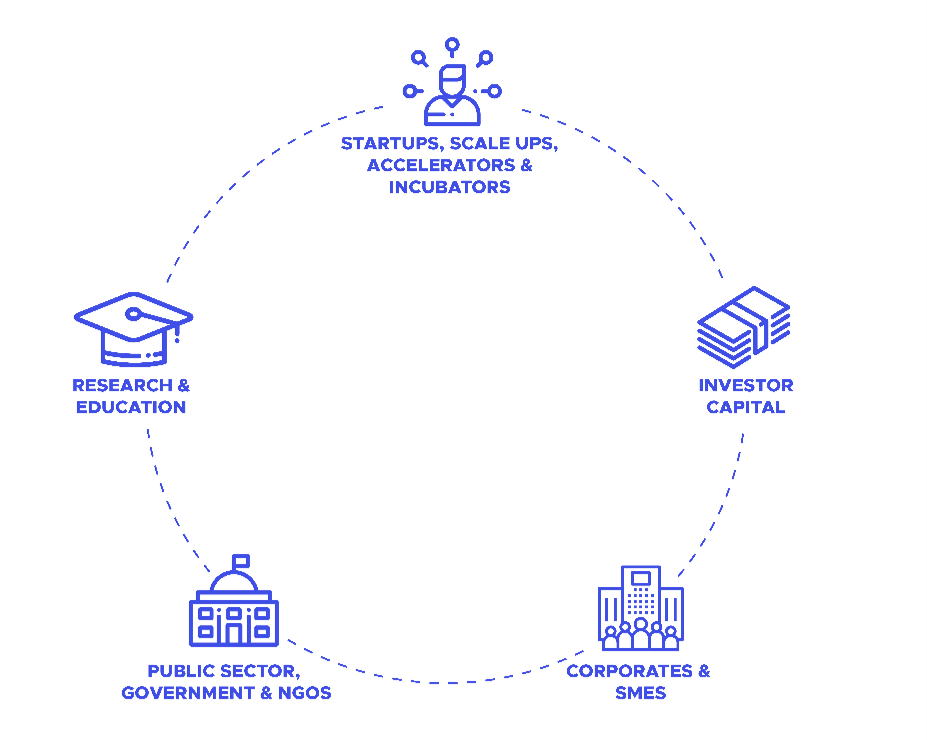
Why does this matter? Because the pentagram connects new ideas to new companies, and new companies to the money that lets them grow. Superclusters become trust-based platforms where companies tackle shared, industry-level challenges they could never solve alone. Done well, they produce value well above the national average, raising productivity, exports and high-quality jobs.
Governments have noticed. Canada committed around CAD 950 million over five years to its Supercluster Initiative, and countries from Thailand to Sweden are building their own programmes. Superclusters are fast becoming a core tool of modern economic development.
What Superclusters could do for Northern Ireland
Northern Ireland is growing, but it is not catching up – yet.
The headline numbers look encouraging. Output grew 2.9% in the year to Q3 2025, ahead of UK GDP growth of 1.3%. Production rose 3.8% while UK production fell.
Underneath, the structural gap persists. GDP per hour worked is £36.96, against a UK average of £41.90. Productivity per worker in the Republic of Ireland is around 40% higher than in Northern Ireland, despite a similar starting point after the Good Friday Agreement. Economic inactivity sits at 26.4%, compared with 20.8% across the UK. The economy has grown largely by adding lower-productivity jobs, which is why living standards have not converged.
The ambition is clear. The Economy Minister's Economic Vision sets four priorities: more good jobs, higher productivity, regional balance and decarbonisation. Invest NI's 2024–27 strategy, Our Future in Focus, turns this into targets that will stimulate economic growth by supporting businesses to invest, increase sales, enhance skills, boost productivity, and encourage innovation.
But targets on their own will not close a gap that has lasted decades. Northern Ireland competes for talent, capital and investment with Dublin, Glasgow, Manchester and fast-moving regions worldwide. Like most regions, it needs to step up. It needs to recognize how the global competition for talent, capital and innovation is accelerating.
This is where Innovation Superclusters come in. Northern Ireland already has real strengths in advanced manufacturing, life and health sciences, software and cyber, and green technology. Built as pentagram platforms, these sectors could:
- link SMEs, multinationals and universities around shared R&D and export missions
- turn research from Queen's and Ulster University into spinouts and scale-ups
- attract venture and growth capital into local companies
- build skills pipelines that lift whole sectors, not single firms
- spread high-value activity beyond Belfast
This is what successful innovation clusters are already doing; in Shenzhen, in Washington State, in Denmark.
How to get started: a path to future prosperity
Invest NI's £11m Cluster Acceleration Programme (CAP) is explicitly built on the Supercluster model, bringing together industry, government, academia, investors and entrepreneurs. Over ten years, it aims to fund up to 50 cluster feasibility studies and up to five Superclusters.
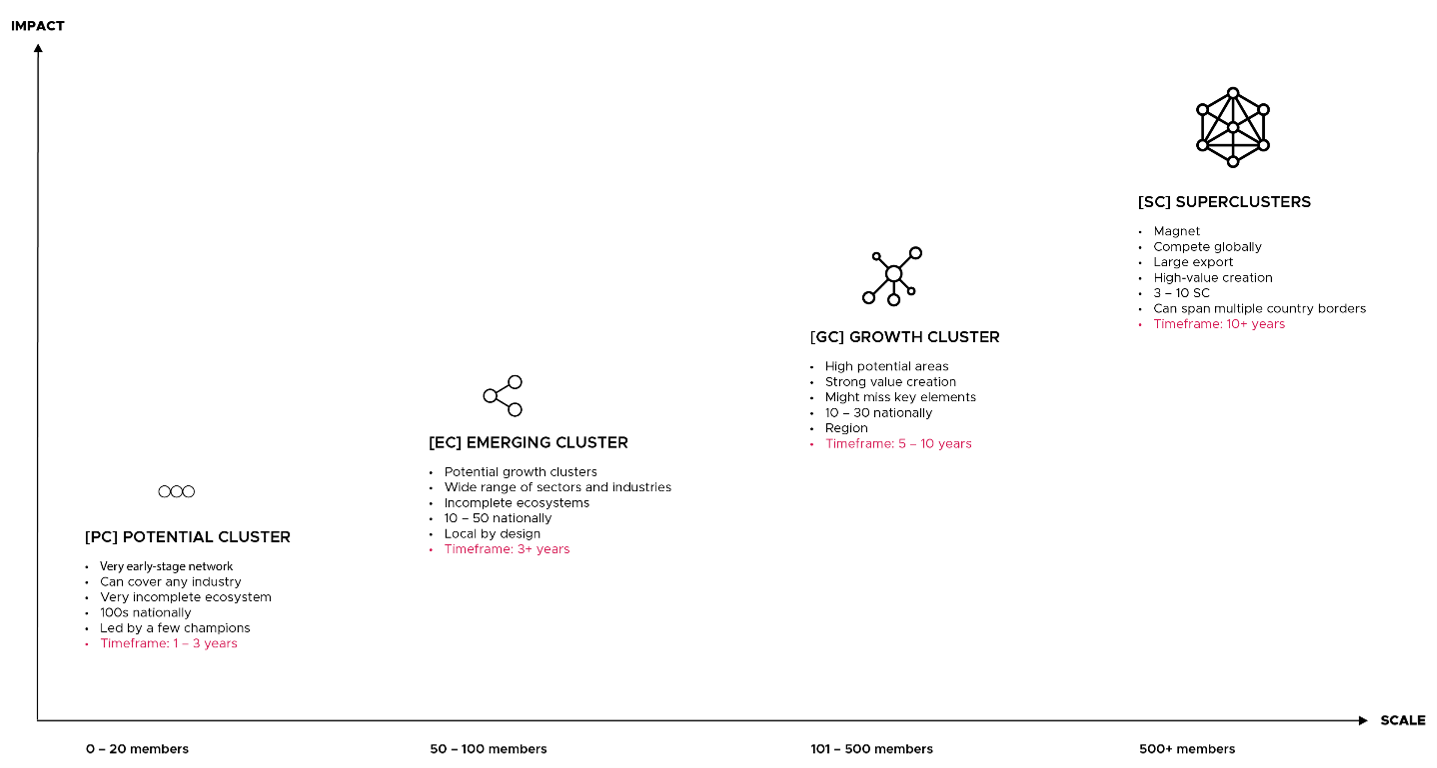
The route runs in two phases. Phase 1 funds feasibility work by business-led networks (what we call PC – Potential Clusters) of at least eight Northern Ireland SMEs. Phase 2 supports emerging clusters that have completed their feasibility study and developed a cluster business model.
From working with more than 450 clusters worldwide, here is how to start well:
- Pick a future-facing industry. Anchor the cluster in a priority sector where Northern Ireland can lead, not just take part. Ask: Where can we take a leading, global position?
- Build the pentagram from day one. Bring in SMEs and anchor companies, universities, government, entrepreneurs and investors. Ask: How can we best connect the parts that are already here?
- Find the shared challenges. Identify problems no single company can solve alone, in skills, R&D, market access or decarbonisation. Ask: what are things we need, but none of us can solve by ourselves?
- Design the cluster business model. Decide how the cluster creates value for members and how it will fund itself beyond the grant. Ask: How do we finance our long-term ambitions together?
- Set a ten-year ambition. Agree clear strategic pillars, KPIs and a first wave of joint projects.
Ask: What does success look like a decade from now, then work backwards from that. - Invest in cluster leadership. Great clusters are run by skilled, dedicated teams. Ask: Who would be willing and able to lead this to a global success story, not just a local success?
Superclusters are not built in a year. But the regions that start now, with ambition and the right model, will shape their industries for decades.
The question for Northern Ireland is not whether to build Superclusters. It is which ones, and how fast.
Sources
- Invest NI: New £11m Cluster Acceleration Programme
- NI Business Info: Cluster Acceleration Programme
- NI Assembly RaISe: Northern Ireland Economic Context (March 2026)
- Invest NI Business Strategy 2024–27, Our Future in Focus
- ESRI evidence to Oireachtas committee on the productivity gap
- Strategy Tools: On Superclusters and Ecosystems
- Strategy Tools: Innovation Supercluster in Six Points
- ECCP: Building Innovation Superclusters report
About the author - Christian Rangen
Christian Rangen is a trusted advisor to governments, ministries, innovation agencies and economic development agencies. Over the past 15+ years he has advised a wide range of countries and regions on national innovation-, transformation- and innovation cluster programs. He has written multiple publications on innovation clusters, ecosystems and scaling up new ventures. Chris is also visiting faculty at multiple business schools, teaching venture capital, strategy, transformation and entrepreneurial finance.
He resides in Stavanger, Norway but travel globally for client engagements and teaching.


Comments