

Fiona Walker, Client Manager, Drinks & Convenience
The spirit of success: Northern Ireland’s distilleries stun on the world stage
Northern Ireland’s distilleries are taking global centre stage. From Bushmills – the world’s oldest licensed whiskey producer – to innovative new distilleries like Killowen, our whiskey, gin, and vodka brands are winning international accolades and becoming worldwide names.
In this article, Fiona Walker discusses what makes Northern Ireland’s distilleries special, from our heritage to our diverse brands.
A protected identity
Irish whiskey is one of the oldest distilled drinks in the world. The Annals of Clonmacnoise in 1405 mention the death of a chieftain from a “surfeit of aqua vitae”, a term that referred to early distilled spirits.
Bushmills Distillery was licensed in 1608, marking the start of our whiskey heritage. Belfast and Dublin dominated the 19th-century whiskey trade. In fact, back in the 1800s Belfast produced more whiskey than any other city on the island of Ireland.
The world wars and prohibition in the early twentieth century reduced the industry across Ireland to two mere distilleries by the 1980s.
That figure more than doubled in the early 2010s, with Echlinville Distillery leading Northern Ireland’s renaissance and becoming the first licensed distillery in the region in over 125 years. Echlinville began production in 2013 and revived heritage brands, such as Dunville’s and Old Comber.
In 2014, the European Union’s (EU) Department of Agriculture granted Irish whiskey a protected European Geographical Indication (GI), safeguarding the industry's reputation.
Over the last decade, Northern Ireland’s drinks sector has become one of the region’s most dynamic, innovative and export-driven industries. We are now home to over 20 distilleries and breweries, crafting whiskey, gin, vodka, beer, cider, rum, and poitín.
An innovative industry
Our drinks producers are winning awards across the globe, driving buoyant sales at home and abroad, and our buzzing visitor centres and tap rooms are enticing tourists into local cities, towns and villages.
Northern Ireland's distilleries draw on our rich natural resources and are adapting, innovating, and diversifying to compete in an ambitious market.
Basalt’s Volcanic Rock gin captures the spirit of the Giant’s Causeway with a hexagon-shaped bottle and uses local botanicals such as Kombu Royale seaweed and sea buckthorn berries. Copeland Distillery encapsulates the coast in its products, sourcing fruits from farms in County Down and Sea Pink Maritima foraged from the Copeland Islands. Hinch Distillery also draws on the local landscape and heritage to build on its brand – its Ninth Wave Irish gin was inspired by Irish mythology.
New and adventurous distillers like Killowen have been inspired by traditional distilling methods, diversifying their product offerings to produce poitín and flavoured liquers. Meanwhile, Wild Atlantic Distillery uses botanicals from the Atlantic Ocean for its gin.
Two Stacks, a blender bonder, has created the world’s first straight whiskey in a can and the first ever single malt in a can. Rademon Estate Distillery, the producer of Shortcross, is also making history, creating the first peated whiskey in the region in over a generation.
Boatyard Distillery was the first Irish distillery to achieve B Corp certification, recognising its commitment to sustainable practices. Its double gin and vodka are 100% organic, and it reuses spent botanicals to make chocolate. Boatyard was named in Drinks International ‘Bartender's Choice’ list for 2026 and also mentioned in the publication’s trending gins and vodkas.
Belfast distillers are also using the city’s heritage to make a mark in the industry. The Titanic Distillers, situated near the slipway of the Titanic and the iconic Titanic Belfast museum, is situated in a pumphouse from 1911 that helped launch the Titanic. The Belfast Distillery Company, based at the historic Crumlin Road Gaol, is blending Northern Ireland’s storied past with modern tourism and reviving McConnell’s Irish Whisky, a brand with roots tracing back to 1776.
Future opportunities
Added to heritage, expertise and innovation is the fact that there has never been a better time to buy Irish whiskey from Northern Ireland.
The EU and US are the largest markets for Northern Ireland distillers, but many of Invest NI’s distillery clients are also finding opportunities in Canada, Japan, Eastern Europe and India.
Northern Ireland is the only place in the world that offers tariff-free market access to both Great Britain and the EU. Sourcing goods from Northern Ireland is easy thanks to our unique market access and regulatory alignment with the EU. This strategic positioning promotes business opportunities and sets the stage for a further boost to our thriving industry.
Northern Ireland’s vibrant distillers have gone far, and there are plenty of new opportunities on the horizon.
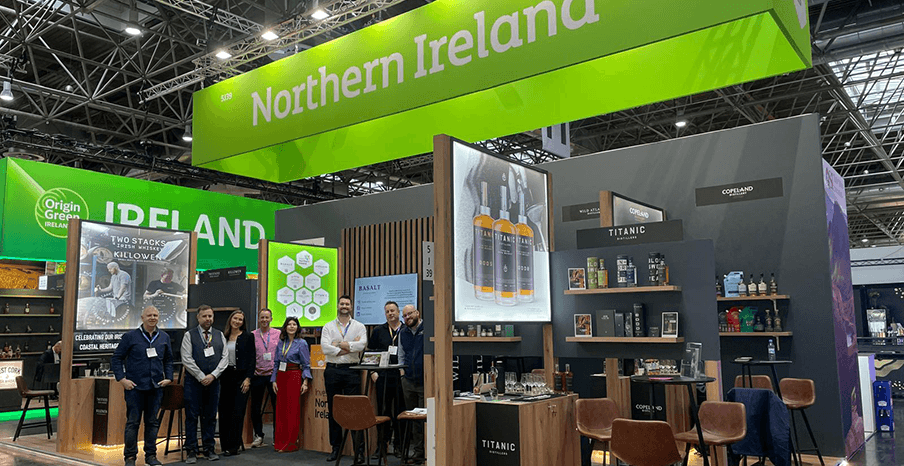
Invest NI brought nine Northern Ireland companies to an exhibition at ProWein in Germany, the world’s largest international trade fair for wine and spirits. We had the opportunity to promote some of Northern Ireland’s best distillers and showcase our impact in the sector. We invited companies to ProWein in 2024 and 2025, which resulted in successful contracts in Europe. Killowen now has a partnership with the German importer Haromex, and Wild Atlantic Distillery are working with Uniq Spirits, a premium drinks distributor.
Invest NI can offer advice on how to utilise dual market access, and can help Northern Ireland distillers become more productive, sustainable, and realise exporting opportunities.
You can read more about our distillers here, or visit our website for our full range of support.
About the Author - Fiona Walker, Client Manager, Drinks & Convenience
Fiona is a Client Manager at Invest Northern Ireland, leading the Drinks & Convenience team within the Food & Drink division. She works with producers across Northern Ireland to drive business growth, capability development, innovation and market expansion. She has played a key role in the rapid growth of Northern Ireland’s distilling sector, supporting its expansion from one active distillery to more than fifteen. Fiona’s work spans strategic account management and wider industry development, working closely with drinks companies as they explore new opportunities and strengthen their commercial reach in key markets.



Comments