

Eugene Heaney, Green Economy Business Development Manager
What is CBAM and how does it affect Northern Ireland businesses?
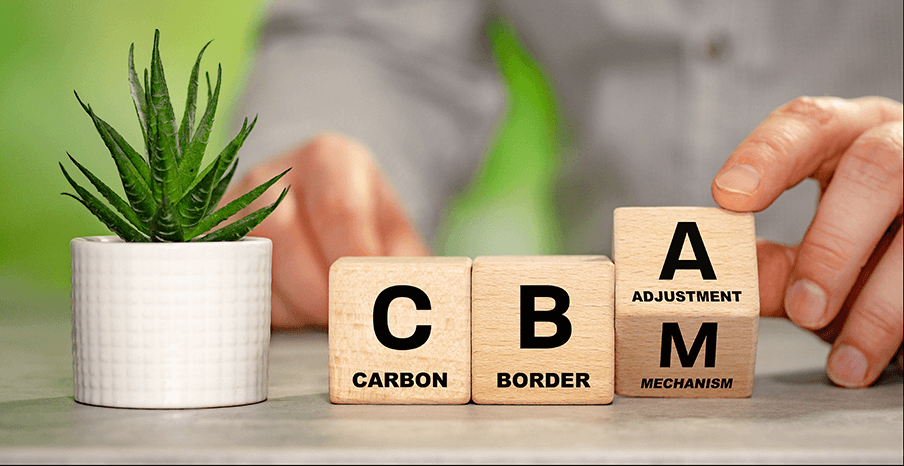
The Carbon Border Adjustment Mechanism (CBAM) is a new environmental policy introduced by the European Union (EU). It aims to put a fair price on the carbon emitted during the production of carbon-intensive goods that are entering the EU.
In this article, Eugene Heaney discusses what CBAM is, why it matters, and what it means for Northern Ireland businesses.
What is CBAM?
EU CBAM is a policy that applies a carbon cost to imported goods, so that products made in countries, primarily outside the EU, with lower carbon pricing do not gain an unfair advantage over cleaner production.
Its core purpose is to reduce “carbon leakage”, where production shifts from EU based manufacturers to jurisdictions with weaker climate rules, and to accelerate low carbon production by making carbon costs more consistent across borders.
From January 2026, EU importers will start accruing costs for the embedded carbon in certain carbon intensive goods. The UK is also planning to introduce its own CBAM equivalent, announced in December 2023. The UK CBAM scheme will launch in 2027.
Why does CBAM matter?
CBAM represents a significant shift in global trade dynamics. Some manufacturers have relocated production to countries with weaker climate policies. This transfers emissions rather than reducing them and can lead to an overall increase in global greenhouse gas emissions.
CBAM will encourage importers to either use factories within the EU or international suppliers that can provide proof of lower carbon emissions. It is meant to complement the EU Emissions Trading System (ETS) by ensuring that imported goods face the same carbon costs as those produced within the EU.
In terms of trade relationships, CBAM legislation is already having an impact. Approximately 23 per cent of global CO₂ emissions are embedded in traded goods, meaning nearly a quarter of emissions are tied to products manufactured in one country and consumed in another.
What does CBAM involve?
Reporting obligations for CBAM began in October 2023.
From 2026 onwards, importers need to purchase CBAM certificates based on the ‘embedded emissions’ of their goods. Embedded emissions refer to greenhouse gas emissions generated during the production and transportation of goods, from the beginning of the manufacturing process to the point where it reaches the end consumer.
CBAM will initially apply to iron and steel, aluminium, cement, fertilisers, electricity, and hydrogen, with future expansion likely to include chemicals and polymers.
For companies trading with the EU, CBAM introduces new compliance requirements and potential cost pressures. Accurate emissions data will be essential, and businesses may need to rethink supply chains to avoid carbon-intensive imports.
Those who fail to adapt risk losing competitiveness in EU markets.
Importantly, CBAM exposure is not limited to primary producers. Any Northern Ireland business importing CBAM-liable goods as inputs or exporting finished products will need accurate emissions information. If they cannot provide this information, they risk becoming less competitive and losing EU market customers.
What CBAM means for Northern Ireland businesses
For Northern Ireland businesses, CBAM is both a challenge and a strategic opportunity.
While CBAM introduces reporting complexity, it also creates a clear incentive for low carbon production.
A clear lesson from early CBAM implementation is this: carbon data should be treated like a product specification and not a last-minute attachment.
Knowing where materials come from, understanding their carbon intensity, and being able to share credible numbers on request is now a sign of commercial competence, and should sit alongside traceability, quality assurance and safety certification. Businesses in Northern Ireland sectors such as renewable energy and advanced manufacturing and engineering have an opportunity to become a preferred supplier to EU markets.
Businesses that invest in decarbonisation and transparent carbon reporting could also gain a competitive edge.
Key market opportunities
Low carbon manufacturing: Northern Ireland firms that can demonstrate reduced emissions and sustainability credentials will stand out in procurement processes where carbon transparency becomes a decisive factor.
Carbon accounting and verification services: There is a growing demand for expertise in emissions tracking and compliance. Northern Ireland businesses in digital technologies, data analytics and professional services are well-positioned to serve the UK and EU markets.
Supply‑chain diversification and export growth: EU buyers may begin preferring suppliers whose products minimise CBAM liabilities. Northern Ireland exporters who can demonstrate lower carbon processes could gain a commercial advantage.
- Inward investment: Companies seeking a lower carbon, EU-aligned production base may increasingly look to Northern Ireland as a location.
Next steps for Northern Ireland businesses
This isn’t a regulatory change to deal with later. It is already shaping purchasing decisions, supply‑chain due diligence, and investment planning across Europe.
Businesses affected by CBAM should:
- Map their product portfolio: Identify which goods, components or upstream materials fall within CBAM sectors.
- Engage suppliers: Gather emissions data, certification information and evidence of decarbonisation.
- Develop simple carbon‑tracking systems: Start building the internal processes needed for quarterly and annual reporting.
- Review production processes: Identify quick wins for energy efficiency, fuel switching or material substitution.
- Seek external support early: Many Northern Ireland firms will benefit from technical, financial and advisory programmes.
CBAM represents one of the most significant shifts in EU trade policy in a generation.
By acting now, Northern Ireland businesses can turn carbon regulation into a competitive advantage, driving growth in the green economy and reinforcing Northern Ireland’s position as a leader in sustainability.
About the Author - Eugene Heaney, Head of Green Economy Development at Invest NI
As Head of Green Economy Development at Invest NI, Eugene focuses on empowering Northern Ireland businesses to seize global green economy opportunities and drive decarbonisation. He joined Invest NI in 2014 following a 20-year career in the construction sector, and has worked across Regional and Skills divisions, successfully assisting start-up businesses and collaborative networks.


Comments